


.webp=s96-fcrop64=1,00000000ffffffff-rw)

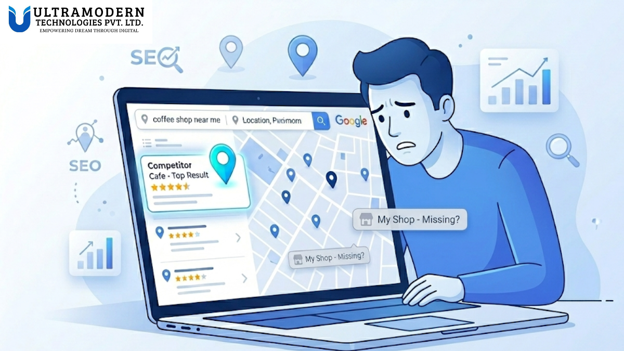
Your business not appearing on Google Maps means lost local customers every day. Learn the real reasons behind low visibility and how to fix your Google Business Profile for better rankings and leads.
Have you ever searched your business name on Google Maps and found nothing? Or maybe you saw a competitor showing up above you even though your business has been around for years. It feels confusing because you know your business is real and your customers trust you, but online it doesn’t look that way.
It's a frustrating experience, and it's more common than most business owners realise. The good news is that it's almost always fixable. The less good news is that the fixes require actual work and some patience there's no switch to flip that makes a business appear overnight.
If you’re a business owner wondering why your business isn’t showing up on Google Maps, this will make things very clear. You don't need to understand algorithms to understand what's going wrong and how to address it. What you do need is an honest explanation of how Google Maps actually works and what specifically causes a business to disappear from or never appear in local results.
Why Google Maps Matters More Than Most Businesses Realise
Before getting into the problems, it's worth spending a moment on why this actually matters. When someone in your area searches for a service you offer a dentist, a chartered accountant, a bakery, a plumber the first thing they see on their phone usually isn't a website. It's a map with three business listings underneath it. This is called the Local Pack, and it's prime real estate in local search.
Studies consistently show that the majority of people searching for local services click on one of those three results. A large portion never scroll past them. If you're not in that pack, you're essentially invisible to the customers most likely to convert the ones who are actively looking for what you offer, right now, in your area.
Google Maps has become one of the most powerful lead generation tools for local businesses, and for most service-area businesses, it drives more enquiries than their website, their social media, and their word-of-mouth referrals combined. A restaurant in Indore, a physiotherapy clinic in Bhopal, a CA firm in Pune for all of these, Google Maps is often the first touchpoint a new customer has with the business. Which is exactly why not appearing there is a genuine business problem.
Why Your Business Isn't Showing Up: The Real Reasons
There isn't usually one single reason. It's typically a combination of factors, and Google Maps is less forgiving of the combination than of any individual issue on its own. Let's go through the most common causes.
Your Google Business Profile Is Incomplete
This is the starting point for most visibility problems. A Google Business Profile (formerly Google My Business) that's missing information sends a clear signal to Google: this business hasn't bothered to present itself properly. Why would we rank it? Incomplete profiles typically lack some combination of: business hours, a proper description, service categories, service areas, website links, and photos. Each missing piece is a missed opportunity to tell Google what you do, who you serve, and where you are.
Your Business Information Is Inconsistent or Incorrect
This one trips up a surprising number of established businesses. Your business name, address, and phone number collectively called NAP need to be consistent everywhere they appear online. Your website, your Google profile, your local directories, your social media pages, your WhatsApp Business account. If your address appears one way on your website and a slightly different way on Google (a different pin code, an abbreviated street name, a different phone number from when you changed providers two years ago), Google treats these as trust issues. It can't be fully confident your listing is accurate, so it deprioritises it.
You Have No Reviews, or Very Few
Reviews are one of the most visible ranking factors in local search, and they function both as a trust signal and as evidence of business activity. A business with no reviews looks to Google like a business that either isn't operating or isn't serving real customers. This isn't just about quantity. A profile with 40 reviews averaging 4.8 stars will almost always outrank a profile with 200 reviews averaging 3.1 stars. Review quality, recency, and the presence of detailed, keyword-rich text in reviews all contribute.
You've Chosen the Wrong Business Category
Category selection has more impact on Maps rankings than most business owners expect. Google uses your primary category as a core relevance signal. A restaurant listed as a "Food and Drink" business instead of specifically as a "Indian Restaurant" or "South Indian Restaurant" is going to struggle to appear for the searches that matter. The problem is often that business owners choose the broadest applicable category rather than the most specific accurate one. More specific categories, when accurate, almost always perform better.
Your Profile Is New and Google Doesn't Trust It Yet
A newly created or recently claimed Google Business Profile has low authority by default. Google doesn't automatically trust new listings the history of fake and spam business profiles is long enough that they've built in scepticism as a feature. A new profile needs consistent signals over time: activity, engagement, reviews, accurate information, and website authority. This process can take anywhere from a few weeks to several months depending on how competitive your local market is.
You Have a Verification Problem
Some profiles are created but never verified. Others are verified but then have their verification lapse after a major information change. An unverified listing either won't appear in Maps at all or will appear with severe ranking limitations. If you've moved premises, changed your phone number significantly, or had someone else set up your profile without completing verification, this could be the root cause.
You Have Duplicate Listings
This happens more than you'd think, especially with businesses that have been around for several years. Google sometimes auto-generates profiles from data aggregators. Previous employees or owners sometimes create their own listings. A business that operated at a different address may have an old listing still floating around.Multiple listings for the same business confuse Google's algorithm and dilute your authority. In some cases they can trigger a penalty that actively suppresses your visibility.
Your Website Has SEO Problems
Your Google Business Profile and your website work together. A profile that links to a slow, thin, or poorly optimised website gets a trust penalty by association. Google wants to send local searchers to businesses that have a credible online presence beyond just the Maps listing. If your website doesn't mention your city or service area, doesn't have basic on-page SEO in place, or takes five seconds to load on a mobile connection, it's dragging your Maps ranking down.
Your Local Relevance Is Low
Google doesn't just look at your profile in isolation it looks at your overall digital footprint in your local area. Are you mentioned on local websites, news sources, and directories? Do other credible local businesses link to you? Is there evidence online that real people in your area know you exist? Low local relevance is a slow-burn problem. It doesn't feel urgent, but over time it becomes the ceiling on how far your ranking can climb.
How Google Decides Who Shows Up
Google uses three main factors to determine which businesses appear in Maps results for any given search. Understanding these helps you understand where to focus your effort.
Relevance is straightforward how physically close the business is to the searcher or to the location they specified in their search. You can't change where your business is, but you can work on the other two factors to compensate for distance disadvantages. Distance is straightforward how physically close the business is to the searcher or to the location they specified in their search. You can't change where your business is, but you can work on the other two factors to compensate for distance disadvantages. Prominence is the interesting one. It measures how well-known and well-regarded Google believes your business to be. This is determined by the volume and quality of your reviews, the authority of websites that mention or link to you, your profile completeness, and your overall online presence. A well-established restaurant with 200 strong reviews, consistent citations across directories, and a properly optimised website will beat a closer competitor with a thin, inactive profile.
Example: Two chartered accountant firms operate in the same part of Indore. Firm A has a complete Google Business Profile, 65 reviews averaging 4.7 stars, regular profile posts, accurate NAP data across 30+ directories, and a website that specifically mentions the services they offer in Indore. Firm B has a basic profile with 8 reviews and a website last updated in 2021. Firm A appears in the top three. Firm B doesn't appear at all. The difference isn't just the reviews. It's the accumulated weight of signals telling Google that Firm A is an active, legitimate, well-regarded business.
How to Fix It: Practical Steps That Actually Work
Here's where to focus your energy. Not all of these will apply equally to your situation, but most businesses with visibility problems need to address the majority of them.
Complete and Optimise Your Google Business Profile:Start here before anything else. Log into your profile and fill in every field that's available to you not just the required ones. Your business description should explain what you do, who you serve, and what makes you different. It should read like something a person wrote, not a keyword list. Add your services or products with descriptions. Set your hours accurately, including special holiday hours. Add your service area if you go to customers rather than having them come to you. The description field allows 750 characters. Use them. Not to stuff keywords, but to give Google and prospective customers a clear picture of your business.
Get Your Categories Right: Review your primary category carefully. Is it the most specific accurate description of your core business? Then add secondary categories for every relevant service type. A business that does website design, SEO, and social media management might have "Web Designer" as the primary category and "Internet Marketing Service," "Social Media Agency," and "SEO Agency" as secondary categories. Each additional accurate category gives you additional relevance signals for the searches those categories cover.
Upload Quality Photos ConsistentlyProfile completeness includes photos, and most businesses treat this as an afterthought. A profile with no photos, or with a single low-resolution image from three years ago, signals neglect. Add photos of your physical location (exterior and interior), your team, your work, your products, and your services in action. Photos should be high quality, properly lit, and genuinely representative of your business. More importantly, add photos regularly. A profile that had photos added once and then went dormant looks less active than one where new images appear periodically. Activity signals matter.
Build a Genuine Review Strategy: Waiting for reviews to happen naturally takes too long. You need a system. After a positive interaction a completed project, a satisfied customer, a successful appointment ask for a review directly. Most people are happy to leave one if the experience was good and they're asked at the right moment. Give them a direct link to your Google review page so there's no friction. Don't incentivise reviews with discounts or gifts. Don't ask for reviews in bulk. Don't create fake reviews. All of these violate Google's policies and the risks from ranking suppression to listing suspension are serious. Respond to every review, positive and negative. A business owner who engages with feedback signals to both Google and prospective customers that the business is attentive and cares about its reputation.
Publish Regular Profile Posts: Google Business Profiles have a posts feature that most businesses ignore entirely. You can post updates, announcements, offers, and event information directly to your profile, and these appear in your listing in search results. Posting consistently even once a week signals that your business is active. Posts expire after seven days for most types, so a profile that posted once six months ago looks dormant.
Fix Your NAP Consistency Do an audit. Search for your business name across Google, JustDial, IndiaMart, Sulekha, Yelp, Facebook, LinkedIn, and any other directory where you might appear. Make sure the name, address, and phone number are identical everywhere. If there are discrepancies old addresses, old phone numbers, abbreviations that differ fix them. This takes time but pays off meaningfully in local ranking improvements.
Build Local Citations: Local citations are mentions of your business name, address, and phone number on other websites directories, local news sites, association listings, industry websites. They function as votes of credibility for your local presence. Being listed accurately on 40 relevant, reputable directories will do more for your local prominence than being listed on 200 generic low-quality ones. Focus on directories that are relevant to your industry and your region.
Improve Your Website's Local SEO: Make sure your website clearly states where you operate. Your city and service area should appear in your page titles, headings, and content naturally not forced, but present. A plumber's website that never mentions Indore anywhere is leaving local relevance on the table. Ensure your website loads fast on mobile. Google uses mobile-first indexing, and a slow site is a ranking liability in local search as much as in regular search.Create pages or content that address specific local needs. A CA firm in Indore that publishes a practical guide to GST filing for Madhya Pradesh businesses is creating locally relevant content that simultaneously helps readers, signals local expertise to Google, and gives other local websites something worth linking to.
The Connection Between Local SEO and Maps Rankings
Google Maps rankings and local SEO are not separate things. They're the same thing approached from two different directions. A strong Google Business Profile without a credible website underperforms. A well-optimised website without a complete, active Google Business Profile underperforms. The two work together, and the businesses that appear consistently at the top of local results are almost always strong on both.
This is why many local businesses particularly those in competitive markets or those trying to recover from a prolonged period of low visibility choose to work with professionals who specialise in this area. A qualified Google My Business service in Indore provider doesn't just set up your profile and walk away. They conduct an audit of your entire local presence, fix the underlying issues, build out your citation profile, and maintain the ongoing activity signals that Google rewards.
Mistakes That Will Get You Into Trouble
Keyword stuffing your business name: Adding your services or city into your listed business name "Sharma & Sons CA Services Indore GST Filing" violates Google's guidelines directly. It also looks unprofessional to customers. Google regularly suspends listings that do this.
Fake reviews:. Buying reviews, getting friends to leave reviews for businesses they've never used, or writing reviews from your own devices Google has become quite good at detecting these patterns. The downside risk is a suspended listing, which is far more damaging than having fewer reviews.
Creating multiple listings for one business:One location, one listing. Duplicate listings dilute your authority and can trigger suppression.
Ignoring your profile after setup:A Google Business Profile that was set up properly two years ago and hasn't been touched since is underperforming. Regular activity matters not just at launch.
Responding badly to negative reviews:Defensive, dismissive, or aggressive responses to negative reviews damage your reputation more than the original review did. A measured, professional response that acknowledges the concern and invites resolution is almost always the right call.
Ignoring the Q&A section:The Questions and Answers section on your profile is publicly visible and anyone can answer the questions including strangers. Monitor it and answer questions yourself before someone else answers them incorrectly.
Where Google Maps Rankings Are Heading in 2026
The fundamentals relevance, distance, prominence aren't going anywhere. But how Google measures and weights these factors continues to evolve, and a few trends are worth understanding now.
Engagement signals are getting heavier:Clicks, direction requests, calls made through your profile, photo views, website visits from your listing these behavioural signals are increasingly feeding into how Google assesses your prominence. A business that people interact with regularly is sending a strong quality signal.
Review quality is outpacing review quantity:Detailed, specific, recent reviews written by accounts with a genuine history are worth more than large volumes of short generic ones. "Great service!" from a brand-new account with no other activity is nearly worthless. A detailed review from a long-standing Google Maps contributor carries real weight.
AI-powered search is changing how results are presented:Google's AI overviews and conversational search features are increasingly presenting business recommendations in response to natural language queries "Who's the best interior designer in Vijay Nagar?" rather than keyword-style searches. Businesses with strong, detailed profiles and consistent positive reviews are more likely to be pulled into these AI-generated recommendations.
Mobile and voice search are the dominant context:The majority of local searches in India happen on mobile. Voice queries are growing. Both tend toward natural language and intent-based searching rather than keyword searching. Businesses whose profiles and websites reflect how real customers talk about their needs are better positioned for this shift.
Business activity as a ranking signal:Google is paying more attention to whether a business profile shows signs of life posts, photo updates, review responses, profile edits. A static profile is increasingly at a disadvantage against an active one, even if the static profile was set up with great care.
A Final Thought
There's no shortcut to consistent Google Maps visibility. The fixes are mostly straightforward, but they require honest assessment of where you currently stand and consistent effort over several months. Most businesses that implement these changes properly start seeing meaningful improvements in three to six months. Some markets are more competitive and take longer.
If you're managing a business and also trying to manage your own local SEO simultaneously, it's worth being realistic about how much you can sustain. Many businesses at a certain stage find that working with a professional Google My Business service in Indore frees them to focus on their actual business while ensuring the technical and strategic work of local visibility gets done properly. Whatever path you choose, focus on building a digital presence that accurately represents a real, active, trustworthy business. Google is trying to serve its users by showing them the best local results. The businesses that genuinely are the best local results, and that communicate that clearly through every available signal, are the ones that show up.
If you’re struggling with Google Maps visibility, a professional Google My Business service in Indore can help fix your profile, improve rankings, and bring more local leads.