


.webp=s96-fcrop64=1,00000000ffffffff-rw)

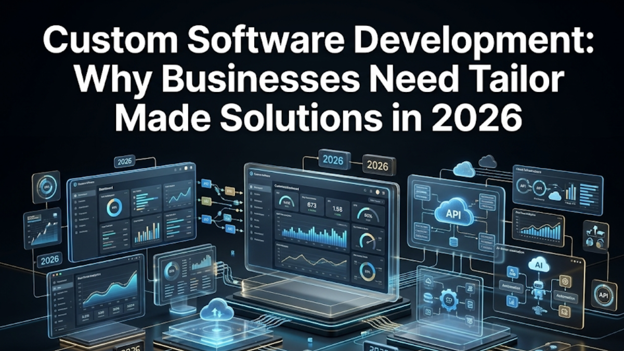
Custom software development helps businesses move beyond generic tools with tailor-made solutions built for scalability, efficiency, and growth in 2026.
Here's a situation that comes up more often than most business owners want to admit.
The company has grown. Revenue is up. The team is bigger. But somewhere along the way, the software stack which made perfect sense at 20 people started creating more problems than it solved. The accounting tool doesn't connect to the CRM. The CRM doesn't connect to inventory. So someone spends two hours every Monday moving data between systems in Excel. A senior manager asks for a weekly report, and it takes half a day to assemble manually because no single dashboard shows the full picture.
Nobody calls this a crisis. It doesn't feel like one. But it is costing real money, real time, and real decision-making quality every single week.
That's the moment custom software stops being something you think about and becomes something you need.
What Custom Software Actually Is
At its simplest, custom software is built for your business rather than adapted from something built for everyone.
Off-the-shelf software is designed for the average company in your category. It covers the most common requirements and handles the standard workflows. That's a reasonable product decision but it means it's built for an average that may not match your actual operation.
Custom software starts with how your business works and builds from there. It can be something relatively narrow a single internal dashboard that pulls data from three systems into one view so your operations team stops toggling between tabs. Or it can be something comprehensive a full ERP managing procurement, production, billing, and multi-location reporting in a single platform you own outright.
What these projects have in common is that they couldn't be bought. They had to be built. And the businesses that built them didn't do it out of tech enthusiasm. They did it because the alternative continuing to adapt their operation around software that almost fit was getting more expensive than building something that actually fit.
Why Standard Software Breaks Down as Businesses Grow
Generic software works well early on. The problems surface gradually, as businesses mature and their "edge cases" multiply.
Take a pharmaceutical distributor managing a few hundred SKUs across multiple zones with region-specific pricing, regulatory documentation requirements, and several supplier relationships operating under different terms. Standard inventory software wasn't designed for that combination. It covers about 75% of the requirement, and the remaining 25% becomes a series of workarounds manual steps, separate spreadsheets, informal processes that depend on institutional memory rather than system logic.
Or a logistics company that runs a fleet with custom route structures, driver performance scoring, and a real-time client visibility portal. The off-the-shelf fleet tools cover standard scenarios. They don't cover the specific configuration that makes this company's service model work.
There's also the integration problem, which quietly causes a lot of damage. Most growing businesses use somewhere between five and ten software tools. Very few of those tools share data cleanly. The result is that the same information exists in multiple places, in slightly different states, and someone has to reconcile them manually. That person usually has better things to do.
Custom software solves this not by being inherently better than packaged software, but by being built for the actual environment it needs to operate in including the other systems around it.
What You Actually Get with a Custom Build
- Your process, unchanged. When software is built around how your team already works, adoption is faster and errors are fewer.
- Ownership. A SaaS subscription gives you access to software someone else controls. Custom software is an asset you own outright.
- Growth that doesn't require migration. Good custom software is built to scale. Adding locations, products, or service lines doesn't mean moving to a different tier.
- A real competitive edge. When your competitors all use the same software, they have the same capabilities. Custom tools give you an advantage they can't replicate by subscribing to the same product.
- Integration that works properly. Rather than bolting on connections between tools as an afterthought, custom development treats integration as a design requirement from the start.
Industries Where the ROI Is Clearest
Custom software is relevant in most industries once operations hit a certain complexity. But a few sectors show the gap between custom and generic most clearly.
Manufacturing
Production planning, quality control tracking, supply chain visibility, machine utilisation manufacturers running custom ERP and shop-floor management systems are making decisions on real data, not on the information that happened to fit a generic platform's field structure.
Healthcare
A hospital management system that covers 70% of a facility's workflows and leaves 30% as manual processes isn't a solution it's a partial solution with a compliance risk attached. Healthcare has enough operational complexity that custom software often delivers meaningfully better outcomes.
Logistics
Route optimisation, proof-of-delivery workflows, client-facing tracking portals, driver management logistics is a sector where operational differentiation directly affects margin. Companies investing in custom operational software are pulling away from those managing on spreadsheets.
Financial Services
Custom lending platforms, insurance workflow tools, portfolio management systems, and compliance-focused automation are areas where regulatory specificity makes generic software genuinely inadequate.
Retail and Ecommerce
Multi-channel inventory management, B2B pricing structures, loyalty programs with custom earning logic retailers with complex operations reliably outgrow packaged solutions.
EdTech and Education
Learning management, student progress tracking, batch scheduling, fee management, parent communication the requirements vary significantly by institution type, which is exactly why packaged solutions tend to miss the specific ones.
How the Development Process Works
Business owners often hesitate on custom software because the process feels opaque. Here's what it actually looks like when it's being done properly.
Discovery
Understanding your business before writing a line of code. A good development team will spend time understanding your current workflows, the systems you already use, who will interact with the software and how, and what success looks like. This produces a documented specification both sides agree to before development starts.
Design
UX design comes before visual design. The structure and logic of how the software will be navigated needs to be right on paper before anything is built. Changes to a wireframe cost hours. Changes to the same decision after development has started cost days.
Development
Development itself is structured in phases working software is delivered incrementally, not as a single reveal at the end. Regular demos and feedback loops keep the build aligned with what you actually need.
Testing & Deployment
Testing covers functionality, performance under load, security, and real-user validation. This isn't a final checkbox it runs throughout. Deployment gets the software into your live environment, your team trained, and the inevitable first-weeks edge cases addressed.
Why Businesses Work with a Software Development Company in Indore
Indore has grown into a credible technology hub. The city's software industry has expanded steadily over the past decade, and the talent pool has deepened alongside it experienced developers, product designers, and technical architects who've worked across manufacturing, healthcare, retail, logistics, and professional services.
For businesses in Central India, the practical advantages of working with a local team go beyond geography. An experienced Software Development Company in Indore understands the operational environment that most of its clients are working in the compliance landscape, the payment and logistics integrations that matter in Indian markets, the infrastructure conditions that affect system design, the user behaviours that should inform how software is built.
There's also the collaboration reality. Time zone alignment matters in complex projects. The ability to meet in person when a decision is genuinely difficult not on a video call, but across a table resolves misalignments that would take weeks of back-and-forth otherwise.
Mistakes That Derail Custom Software Projects
- Choosing on price. Cheap custom software is almost always rebuilt later at higher total cost than doing it properly the first time.
- Skipping reference checks. Ask to see live, working products at similar complexity to yours. Generic portfolios are not evidence of capability.
- Underspecifying the project. Vague briefs produce vague results and contested scope. The more precisely you can describe what the software needs to do, the better the outcome.
- Not planning for post-launch. Who maintains the software? Who applies updates? Who adds features when the business evolves? These need answers before you sign.
- Treating it as a vendor transaction. The best outcomes come from genuine collaboration. Business owners who stay engaged consistently get better software.
Most failed software projects don't fail because of coding they fail because of unclear thinking at the start.
Where Custom Software Is Going
A few directions that are already reshaping what custom software development means.
- AI integration. A custom ERP built in 2026 can incorporate demand forecasting, anomaly detection, and intelligent automation that surface insights without requiring someone to go looking for them.
- Cloud-native architecture. Software built to run on cloud infrastructure scales with usage rather than requiring hardware investments ahead of growth.
- API-first design. Modern custom software connects to the ecosystem around it other internal tools, partner platforms, customer touchpoints as a default rather than an afterthought.
- Mobile-first approach. Field teams, remote staff, and customers all interact with business software on phones. Software built without a mobile-first approach is behind from launch.
A Closing Thought
The businesses getting the most value from custom software aren't the ones with the largest technology budgets. They're the ones who identified a specific operational problem clearly, found a development partner who understood their business, and committed to seeing the build through.
If your business is at the point where the tools are becoming the constraint, the right starting move is a conversation with an experienced Software Development Company in Indore about what's actually possible and what it would involve. Not a commitment just enough clarity to decide whether the timing is right.
The businesses that acted on this early rarely look back. The ones who kept managing the friction tend to wish they'd moved sooner.
Ready to build custom software that fits your business perfectly? Contact UltraModern Technologies your trusted software development partner in Indore.