


.webp=s96-fcrop64=1,00000000ffffffff-rw)

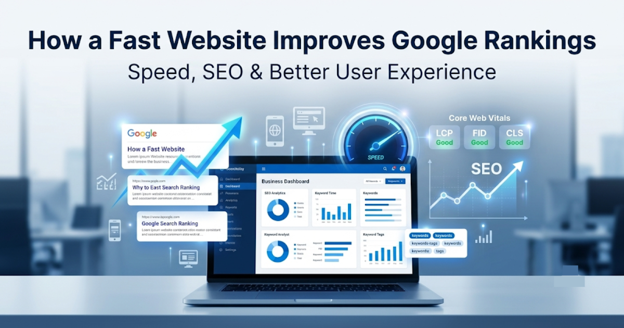
If your website takes more than three seconds to load, you're probably losing visitors before they even see your homepage. And if visitors are leaving, Google notices too.
Website speed isn't just a technical detail anymore. It's a ranking factor, a trust signal, and a direct influence on how many leads or sales your business generates online. Whether you run a local store, a startup, or an established company, a slow website quietly works against you every single day.
In this article, we'll break down exactly why speed matters for SEO, how Core Web Vitals fit into the picture, and what practical steps you can take to fix a sluggish site. We'll also look at why this is especially important for businesses working with a website development company in Indore, where local competition online is growing fast.
Why Website Speed Matters for Google
Google's entire mission is to give users the best possible experience. That means fast, relevant, and useful websites get preference over slow, clunky ones.
Here's the simple logic Google follows:
- A fast website keeps users engaged.
- An engaged user is less likely to bounce back to the search results.
- Low bounce rates signal that your page satisfies search intent.
- Pages that satisfy search intent rank higher.
Speed isn't a standalone factor sitting in isolation. It affects almost every other ranking signal indirectly from user engagement metrics to crawl efficiency. Google's crawlers also have limited time (called "crawl budget") to scan your site. A faster site allows more pages to be indexed in less time, which is especially useful for businesses with product pages, blogs, or service listings.
If you're serious about visibility on search engines, speed has to be part of your foundation, not an afterthought.
Core Web Vitals and SEO
In 2021, Google introduced Core Web Vitals as part of its page experience signals, and they remain highly relevant today. These are three specific metrics that measure real-world user experience:
- Largest Contentful Paint (LCP) – This measures how long it takes for the main content of a page to load. Ideally, this should happen within 2.5 seconds.
- Interaction to Next Paint (INP) – This measures how responsive your page is when a user clicks, taps, or interacts with it. A good score is under 200 milliseconds.
- Cumulative Layout Shift (CLS) – This measures visual stability, how much your page elements jump around while loading. A stable page should score under 0.1.
These three metrics together form a core part of Google's ranking factors, and they're measured using real user data, not just lab tests. That means Google is literally watching how actual visitors experience your website.
For businesses that want long-term organic visibility, working with a team that understands both design and performance is essential. This is exactly where a professional website development company in Indore can help combining clean code, optimized assets, and a fast-loading structure from the ground up.
Mobile Speed and Rankings
Over 60% of search traffic today comes from mobile devices, and Google now uses mobile-first indexing. This means Google primarily looks at the mobile version of your website to determine rankings, not the desktop version.
If your mobile page speed is slow, you're not just losing mobile users; you're losing rankings across the board.
Common mobile speed issues include:
- Large, unoptimized images
- Too many pop-ups or intrusive interstitials
- Render-blocking JavaScript and CSS
- Poor server response times on mobile networks
A responsive, lightweight, mobile-optimized design isn't optional anymore. It's a baseline requirement. Businesses that ignore mobile page speed usually see a noticeable drop in both rankings and conversions, especially in markets where users heavily rely on smartphones for local searches, like restaurants, clinics, or service providers.
How Slow Websites Hurt Conversions
SEO rankings are important, but rankings alone don't pay the bills conversions do. And speed has a massive effect on how many visitors actually become customers.
Consider this: research from Google has shown that as page load time goes from one second to five seconds, the probability of a visitor bouncing increases significantly. Every additional second of delay chips away at your potential leads.
Here's what typically happens on a slow website:
- Visitors leave before the page fully loads.
- Trust is damaged a slow site feels unprofessional or outdated.
- Shopping carts get abandoned.
- Contact forms go unfilled.
- Your ad spend gets wasted, since paid traffic bounces just as fast as organic traffic.
If you're investing in SEO services in Indore or running paid campaigns, slow speed silently cancels out that investment. You could be ranking on page one and still losing customers simply because your site takes too long to open.
Practical Ways to Improve Website Speed
You don't need to be a developer to understand the basics of speed optimization. Here are practical, actionable steps that make a real difference:
- Compress and optimize images – Use modern formats like WebP and compress images before uploading. Large, unoptimized images are one of the most common speed killers.
- Enable browser caching – Caching allows returning visitors to load your site faster by storing certain elements locally.
- Use a Content Delivery Network (CDN) – A CDN serves your website from servers closer to the user's location, reducing load time significantly.
- Minify CSS, JavaScript, and HTML – Removing unnecessary code, spaces, and comments reduces file size and speeds up rendering.
- Choose reliable hosting – Cheap, shared hosting often leads to slow server response times. Investing in quality hosting pays off long-term.
- Reduce redirects – Each redirect adds extra time before the browser can load the final page.
- Audit third-party scripts – Chat widgets, tracking pixels, and plugins can silently slow down your site if not managed properly.
Combining these fixes with a well-structured, custom-coded website is far more effective than relying on generic templates. This is where a dedicated development and optimization partner becomes valuable someone who not only builds the website but also monitors and maintains its performance over time.
Why Businesses in Indore Should Focus on Website Performance
Indore has become one of the fastest-growing business hubs in Central India. From retail and manufacturing to healthcare and education, more local businesses are moving online every year, which means competition for search visibility is increasing too.
For businesses in this market, website speed offers a genuine competitive advantage. A well-optimized, fast-loading website can outrank a bigger competitor simply by offering a better user experience.
Local SEO also plays a major role here. Alongside a fast website, businesses should focus on:
- Optimizing their Google My Business profile in Indore to improve local map rankings.
- Running consistent digital marketing campaigns in Indore to drive qualified traffic.
- Ensuring the website itself is fast, mobile-friendly, and built to convert visitors into leads.
When these elements work together speed, local SEO, and marketing businesses in Indore can build a strong, sustainable online presence instead of relying on one-off tactics.
Conclusion
Website speed is no longer a "nice to have." It directly affects how Google ranks your site, how long visitors stay, and how many of them turn into paying customers. Core Web Vitals, mobile page speed, and overall SEO performance are all connected, and ignoring one usually means falling behind on the others.
If your website feels slow, outdated, or isn't generating the leads you expect, it might be time for a proper technical audit. Partnering with an experienced website development company in Indore ensures your site is built with speed, SEO, and user experience in mind from day one not patched together after the fact.
At UltraModern Technologies, we specialize in building fast, SEO-friendly, and conversion-focused websites for businesses across Indore and beyond. If you're ready to improve your rankings and turn your website into a genuine growth engine, get in touch with our team today for a free website performance consultation.
Frequently Asked Questions
- Does website speed really affect Google rankings? Yes. Google uses page experience signals, including Core Web Vitals, as part of its ranking algorithm. Faster websites generally have better engagement metrics, which supports higher rankings.
- What is a good page load time for SEO? Ideally, your main content should load within 2.5 seconds (as measured by Largest Contentful Paint). Anything beyond 3–4 seconds significantly increases the risk of visitors leaving.
- How do I check my website's Core Web Vitals score? You can use free tools like Google PageSpeed Insights or Google Search Console's Core Web Vitals report to check your scores and identify specific issues.
- Is mobile speed more important than desktop speed? Yes, since Google uses mobile-first indexing, your mobile page speed has a greater direct impact on your search rankings than desktop speed.
- Can a slow website affect my leads and sales, not just rankings? Absolutely. Slow websites lead to higher bounce rates, abandoned forms, and lost trust, all of which reduce conversions even if your traffic numbers stay the same.
Ready to build a faster website? Talk to our team today.